Aluminum Die Casting
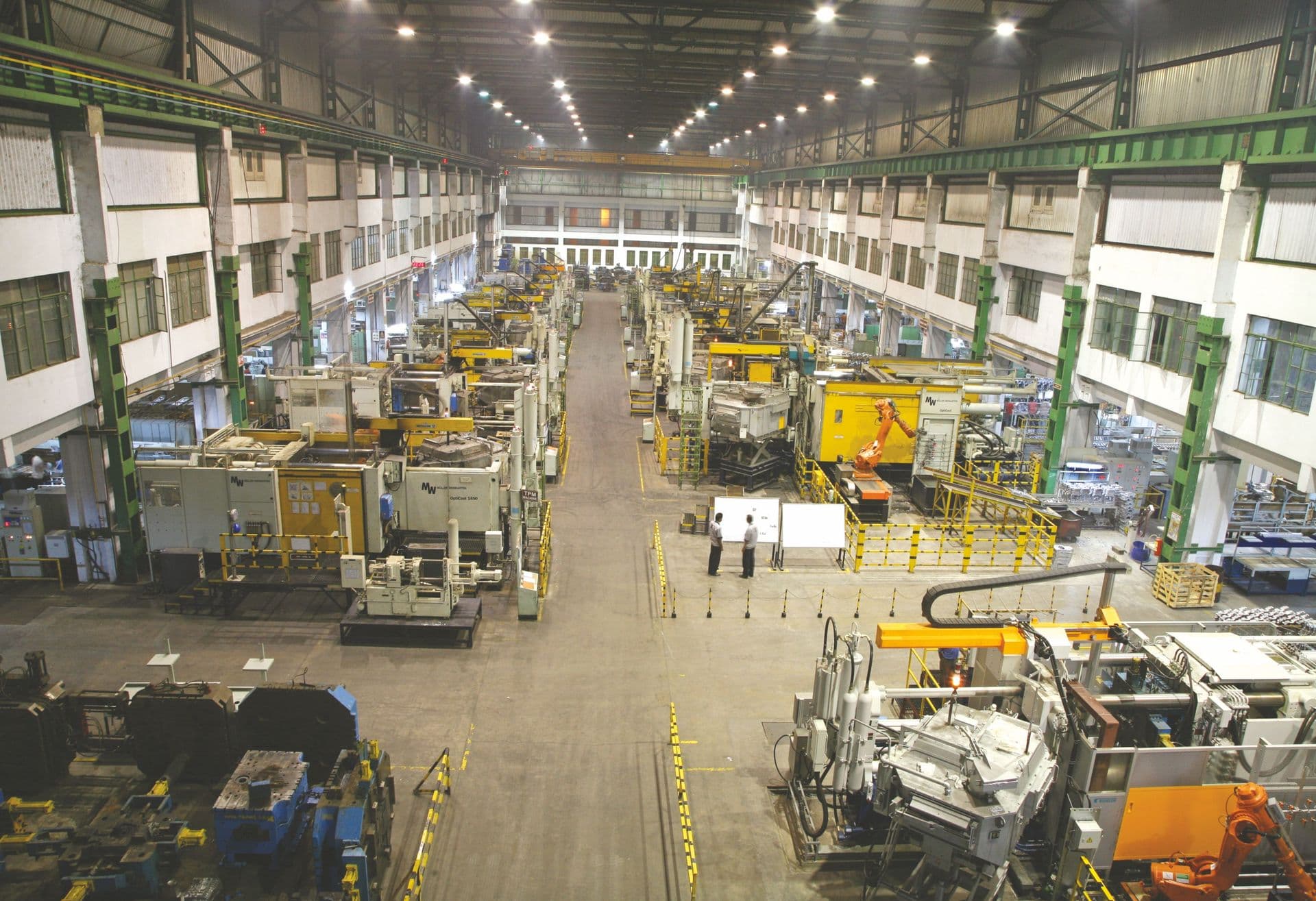
Aluminum die casting produces strong, lightweight components with good thermal and electrical conductivity — a common choice for enclosures, heat-dissipating housings, and structural brackets. Aluminum runs in our cold chamber machines, where molten metal is ladled into the shot sleeve each cycle rather than held in the machine.
Typical applications
- Structural brackets and housings requiring strength-to-weight advantage over zinc
- Heat sinks and thermally conductive enclosures
- EMI-shielding enclosures for electronics
- Components exposed to outdoor or corrosive environments (with appropriate finishing)
Process overview
- 1
Alloy confirmation
You specify the aluminum alloy; we confirm it runs well in our cold chamber process for your part geometry.
- 2
Tool design & build
Die and trim die design account for aluminum's fill and shrink characteristics.
- 3
Casting & trimming
Parts are cast, trimmed, and inspected against the print.
- 4
Machining & finishing
Critical features are machined and parts are powder coated or finished as required.
Part design considerations
- Wall thickness uniformity to control porosity, a common aluminum die casting defect
- Draft and undercuts relative to die complexity and cost
- Finish requirements — aluminum accepts powder coating and other finishes well
DFM guidance
- Design around consistent wall thickness first — porosity risk in aluminum die casting is driven largely by section thickness variation
- We do not produce pressure-tight or leak-tight castings — we run non-vacuum die casting and do not perform leak testing. If your part must hold pressure, source it elsewhere or plan for an impregnation vendor and testing on your side
Quality controls
- First-article inspection against the customer print
- In-process dimensional checks
- Dimensional and visual inspection only — no X-ray, pressure, or leak testing
Secondary operations available
- CNC machining
- Powder coating
- Deburring and trim
- Assembly
Frequently asked questions
Can you produce pressure-tight aluminum castings?
Not as a validated capability. Conventional non-vacuum die casting entrains some gas, which means castings can contain porosity — and we do not perform pressure or leak testing to verify tightness. If your part must hold pressure, you would need impregnation and testing through another supplier. We would rather tell you that now than have it surface at first article.
Ready to talk about your project?
Send your drawings or describe your part — an engineer will follow up, not a sales queue.