
Insert Molding
Insert molding places a pre-formed component — a metal insert, threaded fastener, terminal, or another part — into the mold cavity before plastic is injected around it. The result is a single part combining plastic and a second material without a secondary assembly step.
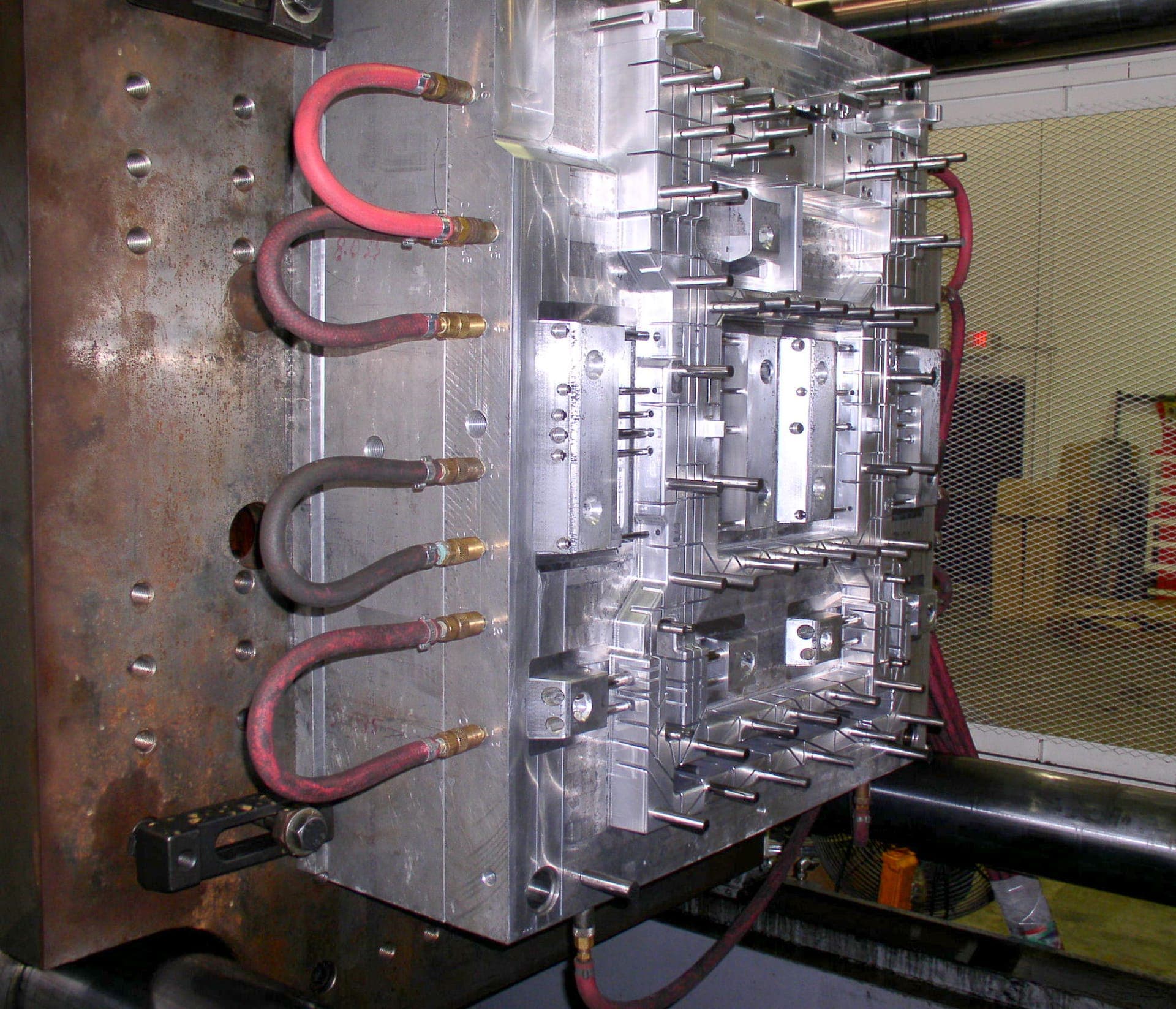
Typical applications
- Threaded metal inserts for repeated fastening in plastic housings
- Electrical terminals and contacts molded directly into connector bodies
- Bearing races or shafts molded into plastic mechanisms
- Multi-material structural components requiring a metal load path
Process overview
- 1
Insert qualification
We confirm the insert's dimensions, material, and how it will be held and located in the cavity before tooling design finalizes.
- 2
Tool design for insert loading
Molds are designed with insert-specific locating features, whether inserts are loaded manually or via automation.
- 3
Molding
Plastic is injected around the pre-placed insert in a single cycle.
- 4
Pull test / retention verification
Insert retention is verified against your requirement (pull-out force, torque-out, or equivalent).
Part design considerations
- Adequate plastic encapsulation around the insert to resist pull-out and torque-out
- Insert placement tolerance and how it affects wall thickness around the insert
- Material compatibility and thermal expansion mismatch between insert and resin
- Whether inserts are loaded manually, semi-automated, or fully automated based on volume
DFM guidance
- Specify required retention force (pull-out and torque-out) up front so we can validate boss geometry around the insert
- Avoid insert features with sharp edges that can create stress risers in the surrounding plastic
- Tell us your annual volume early — it determines whether manual insert loading is practical or automated loading should be tooled in
Quality controls
- Insert retention testing (pull-out / torque-out) documented per your specification
- Visual and dimensional inspection of plastic encapsulation
- Incoming inspection of supplied inserts when customer-furnished
Secondary operations available
- CNC machining of molded features
- Assembly into higher-level components
- Pad printing and decoration
Frequently asked questions
Can Wrex supply the inserts, or do we provide them?
Either — we can source inserts to your specification or mold around customer-furnished inserts, with incoming inspection either way.
How is insert molding different from overmolding?
Insert molding places a rigid, pre-formed part (often metal) into a mold before injecting plastic around it. Overmolding typically bonds a second material — often an elastomer — over an already-molded plastic substrate. See Overmolding for that process.
Ready to talk about your project?
Send your drawings or describe your part — an engineer will follow up, not a sales queue.